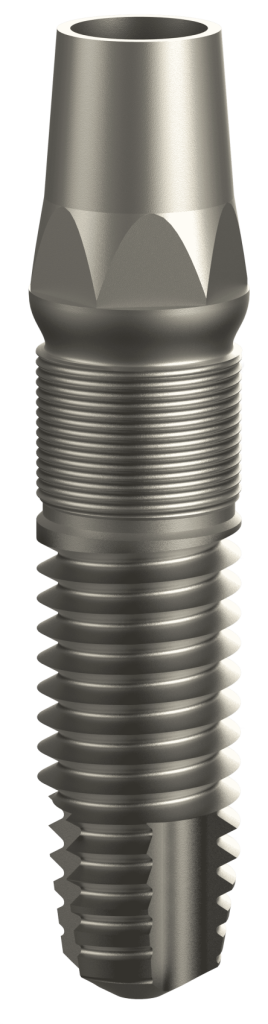
INDICATIONS:
• MANDIBULAR/MAXILLARY IMPLANTO-PROSTHETIC TREATMENTS
• INDICATED IN BONE CLASSES type D1 – D2 – D3
• SUITABLE FOR ALL LEVELS OF EXPERIENCE
AVAILABLE:
Diameter: 3.5 – 4.0 – 4.5 – 5.0 – 5.5
Normal Length: 8 mm – 9 mm – 10 mm – 11 mm – 12 mm
Long Length: 13 mm – 14 mm – 15 mm – 16 mm – 18 mm
Material: Grade 4 Titanium
The single-stage cylindrical implant represents an integrated implantology solution,designed to streamline surgical and prosthetic workflows while maintaining highbiomechanical standards. Its monolithic structure, which combines the implant body andabutment in a single component, eliminates the need for intermediate connections,reducing the risk of micromovements and simplifying clinical management.
The cylindrical geometry with deep threads allows for controlled insertion and uniformforce distribution, ensuring excellent primary stability even in low-density bone. Thismakes the implant particularly suitable for immediate loading and post-extractionprotocols, and for patients with anatomical or systemic limitations.
The single-stage approach reduces surgical and prosthetic times, minimizes operatingphases, and allows for faster rehabilitation, with tangible benefits in terms of patientcomfort and optimization of clinical resources. Furthermore, the absence of a microgapbetween the implant and abutment contributes to the preservation of marginal bone andlong-term soft tissue stability.
For the clinician seeking a reliable, rapid and biomechanically consistent solution, thesingle-stage cylindrical implant offers a solid platform for simplified and predictableimplant treatments.
SINGLE-PHASE CYLINDRICAL SYSTEM
INDICATIONS:
• MANDIBULAR/MAXILLARY IMPLANTO-PROSTHETIC TREATMENTS
• INDICATED IN BONE CLASSES type D1 – D2 – D3
• SUITABLE FOR ALL LEVELS OF EXPERIENCE
AVAILABLE:
Diameter: 3.5 – 4.0 – 4.5 – 5.0 – 5.5
Normal Length: 8 mm – 9 mm – 10 mm – 11 mm – 12 mm
Long Length: 13 mm – 14 mm – 15 mm – 16 mm – 18 mm
Material: Grade 4 Titanium
1. Definition and Structure of the Single-Stage Implant
Single-stage implants integrate fixture and abutment into a single piece, eliminating the connecting screw and any microgaps.
Main advantages:
– Single unit: endosteal body, collar, and emerging abutment.
– One-stage surgery: fewer steps and simplified prosthetic management.
– Absence of microgaps: less bacterial infiltration and better maintenance of the crestal bone peak.
2. Cylindrical Morphology and Biomechanics
The combination of a cylindrical body and advanced thread ensures primary stability, force distribution, and predictable boneintegration.
Cylindrical geometry
– Linear and controlled insertion, with reduced axial deviations.
– Large contact surface for homogeneous osseointegration.
– Adaptability to variable bone densities without excessive cortical compression.
– Reduction of micromovements and axial distribution of forces.
Thread
– Differentiated pitch: coronal microthread for cortical stability, wider pitch in the body for bone condensation.
– 60° triangular profile: greater strength and bone-to-implant contact.
– Self-tapping: atraumatic insertion even in cancellous bone.
– Modulated compression: stability without the risk of overcompression.
– Grade 4 Titanium: high mechanical strength.
– SLA surface: optimal roughness to accelerate osseointegration.
– Flared transmucosal collar: platform switching effect and improved mucosal seal.
3. Surface Treatment
The implant surface undergoes an SLA (sandblasting and double acid etching) treatment, which provides a specific roughness(Ra ≈ 0.5 μm). This characteristic is essential for:
– Accelerating osseointegration: The roughness promotes cell adhesion, collagen production, and faster mineralizationcompared to smooth surfaces.
– Biological Response: While the rough surface promotes cortical bone integration, the flared collar design reduces plaqueaccumulation and promotes an effective mucosal seal.
4. Clinical and Biomechanical Advantages
Clinical
– High primary stability even in D2–D4 bone.
– Ideal for post-extraction and immediate loading.
– Atraumatic insertion with reduced risk of compression necrosis.
– Faster osseointegration thanks to the large contact surface.
– Simplified soft tissue management and improved aesthetics.
Biomechanical
– Uniform distribution of forces and reduction of marginal stress.
– Absence of micromovements, essential for early integration.
– Balance between primary stability and preservation of bone vitality.
– Greater long-term functional durability.
Microthread
– Increases primary stability and resistance to torsion and shear.
– Increases BIC, accelerating osseointegration.
Platform Switching
– The flared collar promotes gingival integration and protection of the bone margin.
5. Operational Efficiency
Reduction of chair time, costs and post-operative discomfort.
6. Clinical Indications
– Single and multiple edentulous teeth, even in small spaces.
– Post-extraction sites with immediate insertion.
– D2–D4 bone thanks to the differentiated thread.
– Immediate loading with temporary prostheses within 24 hours.
– Aesthetic situations requiring predictable soft tissue management.
7. Considerations
They require proper digital planning (CBCT, CAD/CAM) and a learning curve to manage parallelism and occlusal loads.
8. Conclusions
Single-stage implants represent a modern, biomechanically sound and minimally invasive solution, which allows for rapid, stableand biologically safe rehabilitations thanks to highly integrated materials and surfaces.
Platform Switching
It is a design solution for dental implants in which the diameter of the prosthetic abutment is intentionally smaller than the implant platform. This retraction of the connection creates a safety space between the crestal bone and the implant-abutment microgap.
Main benefits
◇ Crestal bone preservation
The innermost connection distances the microcrack from the bone, reducing inflammation and limiting physiological bone loss.
◇ Soft tissue stability
Greater bone stability allows the gum to maintain a more harmonious and predictable profile, improving the aesthetics of the result.
◇ Better biological seal
The increased distance between the bone and the microgap reduces the risk of bacterial infiltration, promoting the long-term health of the implant.
◇ Prosthetic longevity
A more solid bone base ensures greater stability of the prosthesis, reducing complications and improving the overall duration of the treatment.
Scrivici!

Questo sito è rivolto esclusivamente a professionisti del settore odontoiatrico.
Le informazioni presenti riguardano dati, prodotti e materiali sensibili, fondamentali per la tutela della salute e della sicurezza del paziente.
Per accedere al sito, dichiaro sotto la mia responsabilità di essere un operatore sanitario.