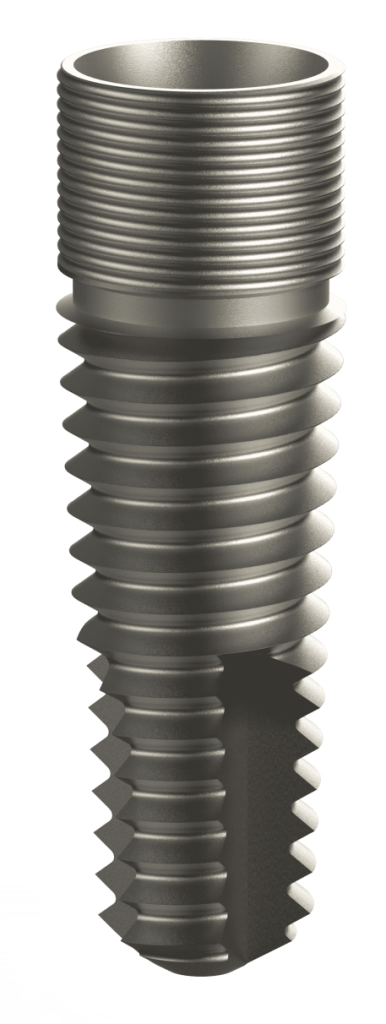
TWO-PHASE CONICAL IMPLANT
INDICATIONS:
• POST-EXTRACTION SITES
• INDICATED FOR ALL BONE CLASSES (bone type D1 – D2 – D3 – D4)
AVAILABLE:
Diameter: 3.5 – 4.0 – 4.5 – 5.0 – 5.5
Normal Length: 8 mm – 9 mm – 10 mm – 11 mm – 12 mm
Long Length: 13 mm – 14 mm – 15 mm – 16 mm – 18 mm
Material: Grade 4 Titanium
The two-stage conical implant represents an advanced synthesis of advanced biomechanics andsurgical flexibility. Designed to ensure high primary stability even in complex bone conditions, thissystem stands out for its progressive conical geometry and separate prosthetic connection, whichallows for optimal soft tissue management and modular rehabilitation.
The conical shape of the implant body promotes bone condensation during insertion, improvingstability in post-extraction sites and in low-density bone. The internal conical connection withhexagonal anti-rotation reduces the microgap and limits micromovements between the implant andabutment, contributing to marginal bone preservation and prosthetic longevity.
Indicated for immediate or delayed loading, the two-stage conical implant adapts to all bone typesand a wide range of clinical indications, from single replacement to full-arch rehabilitation. Itsversatility makes it a strategic choice for clinicians seeking surgical reliability, prosthetic precision, andpredictable long-term results.
TWO-PHASE CONICAL IMPLANT
INDICATIONS:
• POST-EXTRACTION SITES
• INDICATED FOR ALL BONE CLASSES (bone type D1 – D2 – D3 – D4)
AVAILABLE:
Diameter: 3.5 – 4.0 – 4.5 – 5.0 – 5.5
Normal Length: 8 mm – 9 mm – 10 mm – 11 mm – 12 mm
Long Length: 13 mm – 14 mm – 15 mm – 16 mm – 18 mm
Material: Grade 4 Titanium
Main Features
1. Tapered implant body
– Facilitates insertion even in post-extraction sites or with variable bone density.
– Increases primary stability thanks to progressive bone compression.
– Reproduces the natural shape of the root, improving load distribution.
2. Two-stage design (separate implant + abutment)
– Allows for more precise soft tissue management.
– Offers prosthetic flexibility with different abutment heights and angles.
– Eliminates micro-movements during the healing phase.
3. Stable internal connection
– Morse taper connection with anti-rotation internal hexagon
– Ensures a solid fit between fixture and abutment and improved force distribution.
– Reduces the risk of screw loosening and microleakage.
4. Threading
– Differentiated thread pitch: reduced pitch in the coronal portion (microthread) to increase cortical stability; wider pitch in the implant body tofacilitate bone condensation.
– 60° triangular profile: optimizes mechanical resistance and increases the contact surface, reducing the risk of micromovements.
– Self-tapping function: allows for atraumatic and controlled insertion, improving anchoring capacity even in cancellous bone.
– Modulated compression: the thread promotes gradual distribution of forces, preserving bone vitality and reducing the risk of necrosis fromovercompression.
Apical Relief with Progressive Rotation
– Allows the outflow of bone chips.
– Reduces apical pressure during insertion.
– Improves stability in D4 bone.
5. Surface treatment (SLA – sandblasting and double acidification)
– Promotes rapid osseointegration.
– Increases the bone-implant contact surface.
– Improves predictability in complex cases.
6. Compatible with Platform Switching
– Protects the crestal bone.
– Maintains a stable gingival profile.
– Improves aesthetics and longevity of the restoration.
Clinical Benefits
– High primary stability, even in low-density bone.
– Greater soft tissue control, ideal for aesthetic areas.
– Prosthetic versatility for single, multiple, or full-arch rehabilitations.
– Optimal distribution of chewing loads, reducing stress and complications.
In summary
The two-stage conical implant combines stability, versatility and prosthetic precision, offering a reliable solution for most clinical cases, fromsimple rehabilitations to advanced treatments and particularly indicated for immediate post-extraction loading.
Platform Switching
is a dental implant design solution in which the diameter of the prosthetic abutment is intentionally smaller than the implant platform. This retraction of the connection creates a safety space between the crestal bone and the implant-abutment microgap.
Main benefits:
🔹Crestal bone preservation:
The more internal connection distances the microgap from the bone, reducing inflammation and limiting physiological bone loss.
🔹Soft tissue stability
: With more stable bone, the gingiva also maintains a more harmonious and predictable profile, improving the aesthetics of the result.
🔹Better biological seal
: The distance between the bone and the microgap reduces the risk of bacterial infiltration, contributing to the long-term health of the implant.
🔹Prosthetic longevity :
A stronger bone base ensures greater stability of the prosthesis, reducing complications and improving the duration of treatment.
Scrivici!

Questo sito è rivolto esclusivamente a professionisti del settore odontoiatrico.
Le informazioni presenti riguardano dati, prodotti e materiali sensibili, fondamentali per la tutela della salute e della sicurezza del paziente.
Per accedere al sito, dichiaro sotto la mia responsabilità di essere un operatore sanitario.