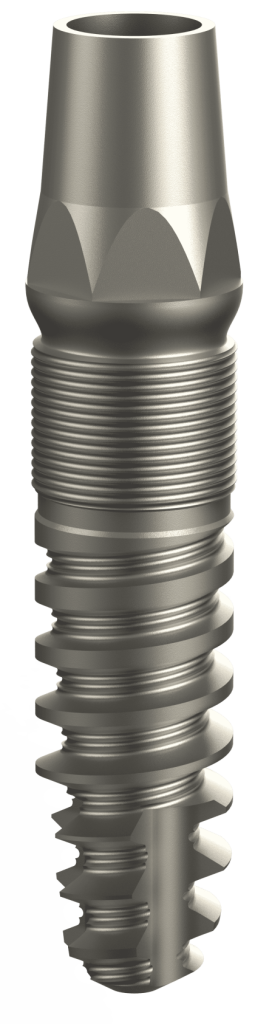
INDICATIONS:
• FOR THE TREATMENT OF UPPER MAXILLARY EDENTULUS
• INDICATED IN BONE CLASSES D3 – D4
• INCREASES PRIMARY STABILITY IN BONE D3 – D4
• EASY TO INSERTION
• THE DOUBLE THREAD WITH PROGRESSIVE TAPER COMPACTS THE BONE DURINGINSERTION
• Promotes crestal bone growth at 5 years
• Over 95% survival in post-extraction sites with immediate loading
• Promotes growth of the papilla and gingival contour
Soft bone management represents one of the most delicate challenges in implantology.The single-stage implant dedicated to D3–D4 densities was created to offer clinicians areliable solution, capable of ensuring high primary stability even in the most complexanatomical contexts. Its aggressive macro-geometry, designed to increase bonecondensation during insertion, allows for secure anchorage in sites characterized by poortrabecular density.
The single-stage structure, without intermediate connections, eliminates the risk of micro-gaps and reduces micromovements, promoting a more stable environment forosseointegration. The integrated abutment also allows for simplified clinical flow, ideal forimmediate loading protocols or rapid rehabilitation in patients with biological or systemiclimitations.
The deep, progressive thread, combined with an optimized conical profile, ensurescontrolled advancement and uniform distribution of forces, reducing the risk of loss ofstability in the first few days post-operatively. This design makes the implant particularlysuitable for thin ridges, post-extraction sites, and posterior areas with low-density bone.
For clinicians who frequently operate in soft bone conditions, the D3–D4 monostageimplant represents a strategic choice: a device designed to maximize predictability,reduce operating times, and ensure stable long-term results.
INDICATIONS:
• FOR THE TREATMENT OF UPPER MAXILLARY EDENTULUS
• INDICATED IN BONE CLASSES D3 – D4
• INCREASES PRIMARY STABILITY IN BONE D3 – D4
• EASY TO INSERTION
• THE DOUBLE THREAD WITH PROGRESSIVE TAPER COMPACTS THE BONE DURING INSERTION
• Promotes crestal bone growth at 5 years
• Over 95% survival in post-extraction sites with immediate loading
• Promotes growth of the papilla and gingival contour
AVAILABLE:
Diameter: 3.5 – 4.0 – 4.5 – 5.0 – 5.5
Normal Length: 8 mm – 9 mm – 10 mm – 11 mm – 12 mm
Long Length: 13 mm – 14 mm – 15 mm – 16 mm – 18 mm
Material: Grade 4 Titanium
Un impianto monofasico è un impianto dentale in cui impianto e moncone protesico sono un’unica struttura.
Non richiede una seconda fase chirurgica e permette un approccio più rapido, soprattutto in casi selezionati.
È particolarmente indicato quando si desidera:
– Ridurre i tempi chirurgici e protesici
– Evitare una seconda esposizione chirurgica
– Ottenere una stabilità immediata in osso adeguato
– Gestire protesi provvisorie o definitive in tempi rapidi
1. Contesto Clinico: Osso D3–D4
Gli impianti Easyfor D3–D4 garantiscono stabilità primaria elevata in condizioni di densità ossea ridotta.
• D3 → osso spugnoso a media densità
• D4 → osso molto morbido, altamente trabecolare
In questi casi, il design dell’impianto è determinante per ottenere una presa iniziale efficace e una osteointegrazione predicibile.
2. Caratteristiche Tecniche dell’Impianto Monofasico D3–D4
Struttura Monoblocco – Impianto e moncone sono un’unica unità.
– Nessun microgap → riduzione del rischio di infiltrazione batterica.
– Maggiore rigidità meccanica.
Macro‑Design Conico
– Favorisce la compressione laterale dell’osso spugnoso.
– Aumenta la stabilità primaria in osso morbido.
– Ideale per creste sottili e siti post‑estrattivi.
Filettatura Aggressiva a Conicità Progressiva
– Autofilettante, progettata per condensare l’osso D3–D4 durante l’inserimento.
– Migliora il contatto osso‑impianto (BIC).
– Permette un inserimento controllato anche in osso molto morbido.
Microfiletto Crestale
– Aggancio corticale anche quando la corticale è sottile.
– Riduzione del riassorbimento osseo marginale.
– Stabilizzazione dei tessuti molli.
Superficie SLA (sabbiatura + doppia acidificazione)
– Rugosità ottimale per una rapida osteointegrazione.
– Favorisce la ritenzione del coagulo nelle prime fasi.
– Fondamentale nei casi di osso rigenerato.
Apice Arrotondato
– Atraumatico, si adatta perfettamente alla fresatura.
3. Utilizzi Clinici Ideali
– Densità ossea tipo D3–D4 (Cawold e Howell)
– Siti Post‑Estrattivi – La forma conica e la filettatura progressiva migliorano la presa nelle pareti alveolari residue.
– Siti Rigenerati-Spesso assimilabili a D4 per densità e comportamento meccanico.
– Riabilitazioni Rapide-Il design monofasico permette protocolli semplificati e tempi ridotti.
– Carico Immediato (in casi selezionati)-solo se la stabilità primaria raggiunge valori clinicamente adeguati.
– Protesi Fisse o Overdenture – Soluzione efficace per riabilitazioni economiche e veloci.
4. Advantages for the Clinician
– High primary stability in soft bone.
– No second surgical stage.
– Reduction of micromovements thanks to the monoblock structure.
– Rapid osseointegration thanks to the SLA surface (sandblasted + double acid-etched)
– Predictability even in complex cases (D3–D4, regenerated).
– Ease of operation and reduced clinical times.
5. In Summary
A monophasic conical implant for D3–D4 bone combines:
– monoblock structure,
– macro-conical design,
– aggressive thread,
– crestal microthread,
– SLA surface, to ensure high primary stability, rapid osseointegration and clinical success even in the most unfavorable boneconditions.
Platform Switching
is a dental implant design solution in which the diameter of the prosthetic abutment is intentionally smaller than the implant platform. This retraction of the connection creates a safety space between the crestal bone and the implant-abutment microgap.
Main benefits:
🔹Crestal bone preservation:
The more internal connection distances the microgap from the bone, reducing inflammation and limiting physiological bone loss.
🔹Soft tissue stability
: With more stable bone, the gingiva also maintains a more harmonious and predictable profile, improving the aesthetics of the result.
🔹Better biological seal
: The distance between the bone and the microgap reduces the risk of bacterial infiltration, contributing to the long-term health of the implant.
🔹Prosthetic longevity :
A stronger bone base ensures greater stability of the prosthesis, reducing complications and improving the duration of treatment.
Scrivici!

Questo sito è rivolto esclusivamente a professionisti del settore odontoiatrico.
Le informazioni presenti riguardano dati, prodotti e materiali sensibili, fondamentali per la tutela della salute e della sicurezza del paziente.
Per accedere al sito, dichiaro sotto la mia responsabilità di essere un operatore sanitario.