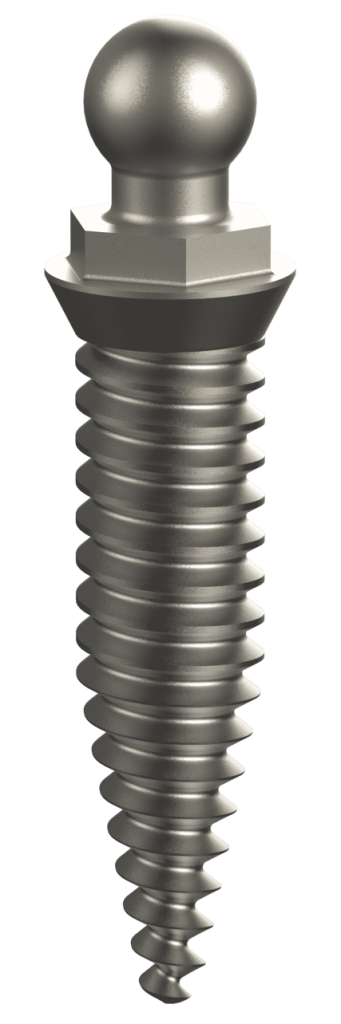
INDICATIONS:
• FOR THE MANDIBULAR BONE
• INDICATED FOR STABILIZING DEFINITIVE REMOVABLE PROSTHESES OR TEMPORARYPROSTHESES
AVAILABLE:
Diameter: 2.8 mm
Length: 10 mm – 11 mm – 12 mm – 13 mm – 14 mm
Material: Grade 5 Titanium
Mini dental implants with a diameter of 2.8 mm represent a highly effective clinicalsolution for prosthetic stabilization in patients with thin ridges, limited bone, or systemicconditions that make regenerative procedures complex. Thanks to their streamlineddesign and minimally invasive surgery, these implants allow for rapid, atraumatic insertionwith reduced healing times, while maintaining high standards of primary stability.
Available with a ball or hex attachment, mini implants offer clinicians two prostheticoptions.
The deep thread and optimized implant profile facilitate grip even in low-density bone,making these implants particularly suitable for elderly patients, advanced resorption, orrapid rehabilitation. The single-stage approach simplifies clinical flow, reduces thenumber of appointments, and allows for immediate or early prosthetic management.
For clinicians seeking a reliable, versatile, and minimally invasive solution, mini implantswith a diameter of 2.8 mm represent a strategic tool for expanding treatment optionsand offering functional rehabilitation even in the most complex cases.
INDICATIONS:
• FOR THE MANDIBULAR BONE
• INDICATED FOR STABILIZING DEFINITIVE REMOVABLE PROSTHESES OR TEMPORARY PROSTHESES
AVAILABLE:
Diameter: 2.8 mm
Length: 10 mm – 11 mm – 12 mm – 13 mm – 14 mm
Material: Grade 5 Titanium
Mini dental implants are designed to provide prosthetic stability in conditions of thin or very thin bone crest (class IV) or when aless invasive surgical procedure is desired.
They have a monoblock structure:
• with a ball or hexagonal abutment for the prosthesis (often to support overdentures)
1. Main features
– Small diameter (2.8 mm)
– Allows insertion even in thin ridges without the need for bone regeneration.
– Minimally invasive procedure
– Flapless insertion in most cases
– Reduced surgical trauma
– Faster healing times and less post-operative discomfort.
• High strength materials
– Grade 5 titanium
• Monoblock structure
– No fixture-abutment connection
– Reduction of the risk of loosening components
– Greater prosthetic simplicity
• Immediate loading
– In many cases it is possible to stabilize the prosthesis in the same session
– Particularly useful for mandibular overdentures.
1. Threading and Connection
– Thread: Self-tapping with compression threads for great primary stability.
– DRILLING WITH A SINGLE DRILL
– Smooth transmucosal neck
– Has a hexagon for insertion with a drill mounter
– Spherical head compatible with Rhein prosthetic components
2. Surface treatment
– SLA surface treatment (sandblasting + double acid etching)
– Promotes rapid osseointegration.
– Improves osseointegration even in small-diameter implants.
4. Clinical uses
• Stabilization of overdentures is the most common indication:
– Mandibular overdenture
– Improves stability, retention and comfort
– Ideal solution for patients with limited bone or who do not want invasive surgery.
• Replacement of single teeth in small spaces
– Lower incisors
– Limited mesio-distal spaces
– Young patients or patients with particular anatomies
• Patients with limited bone
– Thin ridges
– Moderate atrophy
– Situations where traditional implantation would require GBR or grafts
• Elderly or frail patients
– Reduced invasiveness
– Rapid times
– Fewer systemic contraindications compared to more complex interventions
5. More economically accessible solution
– Lower costs than traditional implants
– Reduction in overall surgical and prosthetic costs
Important clinical considerations
• Not ideal for extended fixed rehabilitations
• Require good bone quality (D1–D3 preferred)
• Case selection is critical for success
• Excellent for patients looking for a quick, stable and less invasive solution
Scrivici!

Questo sito è rivolto esclusivamente a professionisti del settore odontoiatrico.
Le informazioni presenti riguardano dati, prodotti e materiali sensibili, fondamentali per la tutela della salute e della sicurezza del paziente.
Per accedere al sito, dichiaro sotto la mia responsabilità di essere un operatore sanitario.