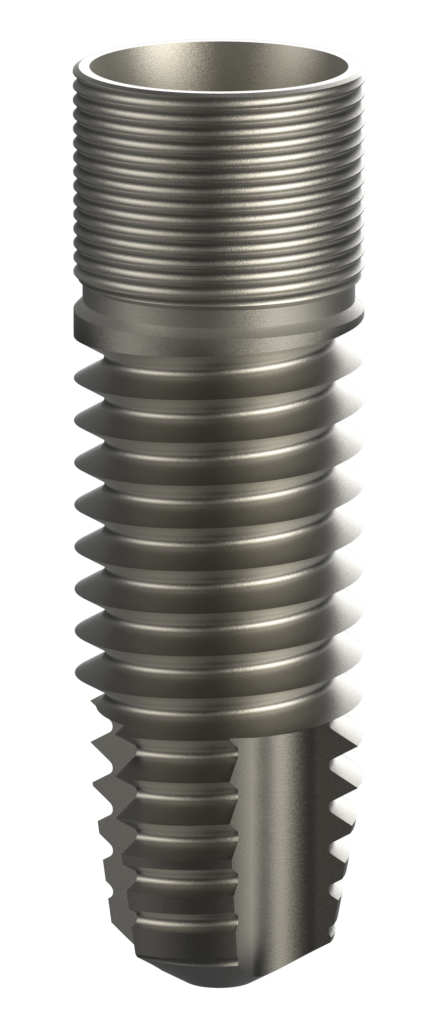
INDICATIONS:
• MANDIBULAR/MAXILLARY IMPLANTO-PROSTHETIC TREATMENTS
• INDICATED IN BONE CLASSES D1 – D2 – D3
• SUITABLE FOR ALL LEVELS OF EXPERIENCE
• THE MOST USED FORM
• OVER 98% SUCCESS RATE
AVAILABLE:
Diameter: 3.5 – 4.0 – 4.5 – 5.0 – 5.5
Normal Length: 8 mm – 9 mm – 10 mm – 11 mm – 12 mm
Long Length: 13 mm – 14 mm – 15 mm – 16 mm – 18 mm
Material: Grade 4 Titanium
In the contemporary implant landscape, clinical predictability is no longer a goal: it’s an essentialrequirement. The two-stage cylindrical dental implant was created to address this need, offeringprofessionals a stable, versatile solution designed to integrate seamlessly with the most commonsurgical protocols.
Thanks to its optimized cylindrical geometry and two-stage configuration, this implant ensuressuperior control during insertion, uniform force distribution, and a prosthetic interface that simplifiesthe clinician’s work without compromising precision. The result is a reliable system, designed to adaptto varying bone densities and to support a safe, progressive, and long-lasting rehabilitation process.
For professionals seeking an intuitive, high-performance implant consistent with the latest scientificevidence, the two-stage cylindrical implant represents a solid choice: a balance of surgical simplicity,primary stability, and prosthetic flexibility.
TWO-PHASE CYLINDRICAL IMPLANT
INDICATIONS:
• MANDIBULAR/MAXILLARY IMPLANTO-PROSTHETIC TREATMENTS
• INDICATED IN BONE CLASSES D1 – D2 – D3
• SUITABLE FOR ALL EXPERIENCE LEVELS
• THE MOST USED SHAPE
• OVER 98% SUCCESS RATE
AVAILABLE:
Diameter: 3.5 – 4.0 – 4.5 – 5.0 – 5.5
Normal Length: 8 mm – 9 mm – 10 mm – 11 mm – 12 mm
Long Length: 13 mm – 14 mm – 15 mm – 16 mm – 18 mm
Material: Grade 4 Titanium
1. Definition and Structure
The two-stage cylindrical implant is an implant system composed of two distinct elements:
• Endosseous fixture (implant screw)
• Prosthetic abutment
The procedure involves two surgical phases, as is typical for two-stage implants:
1. Insertion of the fixture into the bone.
2. Application of the healing screw or abutment at a later stage.
2. Geometria e Macro‑Design
• Corpo cilindrico a pareti parallele per una distribuzione uniforme delle forze.
• Apice arrotondato o leggermente smussato per ridurre il trauma chirurgico.
• Filetti a passo differenziato: passo ridotto nella porzione coronale (microfiletto) per aumentare la stabilità corticale; passo più ampio nel corpodell’impianto per facilitare la condensazione ossea.
– Profilo triangolare 60°: ottimizza la resistenza meccanica e incrementa la superficie di contatto, riducendo il rischio di micromovimenti.
– Funzione autofilettante: consente un inserimento atraumatico e controllato, migliorando la capacità di ancoraggio anche in osso spugnoso.
– Compressione modulata: la filettatura favorisce una distribuzione graduale delle forze, preservando la vitalità ossea e riducendo il rischio dinecrosi da sovracompressione.
Scarico Apicale a Rotazione Progressiva
– Permette il deflusso dei frustoli ossei.
– Riduce la pressione apicale durante l’inserimento.
– Migliora la stabilità in osso D4.
– Elevata stabilità primaria anche in osso non compatto
3. Connessione Implanto‑Protesica
• Connessione conometrica morse con esagono interno antirotazione
4. Trattamento superficiale
• Trattamento superficiale SLA (sabbiatura + doppia acidificazione)
– Favorisce una rapida osteointegrazione.
– Aumenta la superficie di contatto osso-impianto.
– Migliora la predicibilità nei casi complessi.
5. Indicazioni Cliniche
L’impianto cilindrico bifasico è adatto per:
• Riabilitazioni singole, multiple e full‑arch.
• Osso di densità D1–D2-D3.
• Procedure con tecnica a lembo o flapless.
• Carico immediato in casi con stabilità primaria adeguata.
• Siti rigenerati o con qualità ossea ridotta
6. Vantaggi Clinici
• Facile inserimento grazie alla geometria cilindrica.
• Ottima stabilità primaria anche in osso morbido.
• Distribuzione uniforme delle forze lungo la fixture.
• Versatilità chirurgica in tutte le procedure implantari.
• Affidabilità meccanica della connessione interna.
• Adatto al carico immediato quando la stabilità primaria lo consente.
7. Uses
Bi-stage cylindrical implants are indicated in:
• Standard rehabilitations with adequate bone.
• Stabilized post-extraction sites.
• Situations in which a less aggressive insertion is desired compared to tapered implants.
• Cases in which predictability of depth and direction during insertion is preferable.
8. In Summary
The bi-stage cylindrical implant represents a reliable, versatile and biomechanically stable solution.
Its parallel geometry, internal connection and treated surface make it ideal for most implant rehabilitations, with excellent results in terms ofosseointegration and long-term durability.
Platform Switching
is a dental implant design solution in which the diameter of the prosthetic abutment is intentionally smaller than the implant platform. This retraction of the connection creates a safety space between the crestal bone and the implant-abutment microgap.
Main benefits:
🔹Crestal bone preservation:
The more internal connection distances the microgap from the bone, reducing inflammation and limiting physiological bone loss.
🔹Soft tissue stability
With more stable bone, the gingiva also maintains a more harmonious and predictable profile, improving the aesthetics of the result.
🔹Better biological seal
The distance between the bone and the microgap reduces the risk of bacterial infiltration, contributing to the long-term health of the implant.
🔹Prosthetic longevity :
A stronger bone base ensures greater stability of the prosthesis, reducing complications and improving the duration of treatment.
Scrivici!

Questo sito è rivolto esclusivamente a professionisti del settore odontoiatrico.
Le informazioni presenti riguardano dati, prodotti e materiali sensibili, fondamentali per la tutela della salute e della sicurezza del paziente.
Per accedere al sito, dichiaro sotto la mia responsabilità di essere un operatore sanitario.