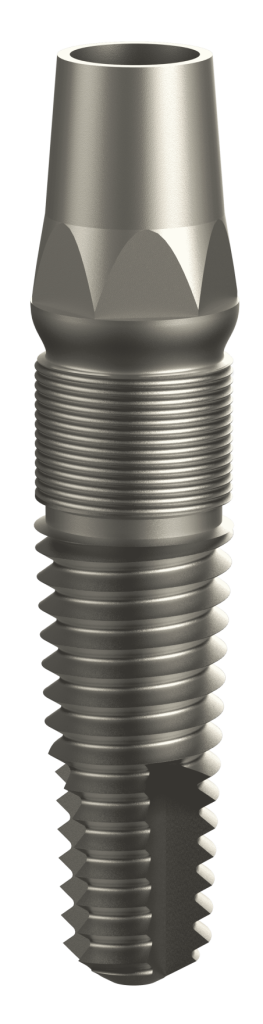
SINGLE-PHASE CONICAL IMPLANT
INDICATIONS:
• POST-EXTRACTION SITES
• INDICATED FOR ALL BONE CLASSES (bone type D1 – D2 – D3 – D4)
AVAILABLE:
Diameter: 3.5 – 4.0 – 4.5 – 5.0 – 5.5
Normal Length: 8 mm – 9 mm – 10 mm – 11 mm – 12 mm
Long Length: 13 mm – 14 mm – 15 mm – 16 mm – 18 mm
Material: Grade 4 Titanium
The monostage tapered implant is a surgical solution designed to maximize primary stability andreduce surgical complexity. Its unitary structure, integrating the implant body and abutment into asingle component, eliminates intermediate connections and potential microgaps, offering animmediately accessible and biomechanically stable prosthetic interface.
The macro-tapered geometry promotes bone condensation during insertion, improving grip in low-density sites and making the implant particularly suitable for immediate loading and post-extractionprotocols. The progressive thread ensures controlled advancement and optimal force distribution,contributing to marginal bone preservation and long-term tissue stability.
The monostage design allows for a faster and more streamlined clinical flow: fewer surgical steps,reduced healing times, and simplified prosthetic management. This approach meets the needs ofclinicians seeking operational efficiency without sacrificing biomechanical predictability.
For professionals who want a reliable, stable implant aimed at rapid rehabilitation, the monophasicconical system represents a solid, modern and clinically advantageous choice.
SINGLE-PHASE CONICAL IMPLANT
INDICATIONS:
• POST-EXTRACTION SITES
• INDICATED FOR ALL BONE CLASSES (bone type D1 – D2 – D3 – D4)
AVAILABLE:
Diameter: 3.5 – 4.0 – 4.5 – 5.0 – 5.5
Normal Length: 8 mm – 9 mm – 10 mm – 11 mm – 12 mm
Long Length: 13 mm – 14 mm – 15 mm – 16 mm – 18 mm
Material: Grade 4 Titanium
1. System Definition and Philosophy
The monophasic (one-piece) implant integrates the endosseous body and transmucosal abutment in a single structure, allowing surgicalinsertion and prosthetic preparation in a single phase, without the need for subsequent uncovering as in two-phase systems.
2. Technical Characteristics and Materials
– Conical and threaded geometry: The conical shape with rounded apex reduces bone trauma, improves primary stability and promotesimmediate loading, adapting even to thin or atrophic ridges.
– Materials: Made of Grade 4 Titanium (Ti-6Al-4V), they guarantee high mechanical strength and durability.
– SLA surface: The roughness obtained by sandblasting and double acidification accelerates osseointegration and increases bone-implantcontact.
– Flared transmucosal collar: Promotes mucosal seal and reduces plaque accumulation.
3. Clinical and Biomechanical Advantages
– No microgap: The one-piece structure eliminates the implant-abutment gap, preventing bacterial infiltration and marginal resorption.
– Structural integrity: No risk of loosening or fracture of the connecting screw, improving mechanical stability.
– Immediate soft tissue conditioning: No second intervention; the gingiva immediately adapts to the definitive abutment.
Microthread:
– Increases primary stability, essential for immediate loading;
– Increases BIC, improving osseointegration and resistance to forces;
– Contributes to stress distribution.
“Intrinsic” platform switching:
– The conical geometry and flared collar direct stress away from sensitive tissue, simulating the effect of platform switching.
4. Stress Distribution and Marginal Bone Protection
– Differentiated roughness (Ra ≈ 0.5 μm): Promotes cortical osseointegration and limits plaque.
– Reduction of resorption: The microthread uniformly distributes stress, preserving marginal bone.
– Mechanical strength: Grade 4 titanium maintains the integrity of microstructures even under high loads.
5. Biological Response
– Rough surfaces promote cell adhesion, collagen production, and faster mineralization than smooth surfaces.
– Structural continuity and the tapered transmucosal tract improve mucosal seal and protect cortical bone.
– High primary stability allows for immediate loading protocols (24–72 hours).
– The one-piece design eliminates micromovements and screw-tightening stresses typical of two-stage implants.
6. Operational efficiency:
– Reduction in clinical times, costs and post-operative discomfort.
7. Clinical Indications
– Immediate loading: Ideal for fixed temporary prostheses within 24–72 hours.
– All-on-Four/Six
– Atrophic ridges: Less invasive than two-stage restorations in the presence of limited bone.
– Aesthetic areas: Immediate management of the emergence profile and tissue conditioning for stable aesthetic results.
8. Professional Considerations
– They require an adequate learning curve and accurate digital planning (CBCT, CAD/CAM).
– They offer less prosthetic flexibility than two-stage implants (non-replaceable abutment).
– They require extremely precise surgical positioning.
– Not indicated for cases with particularly complex aesthetic requirements.
9. Conclusions
Single-stage implants represent an advanced, biomechanically sound, and minimally invasive solution. They enable rapid, stable, and biologicallysafe rehabilitations, thanks to high-performance materials and a design optimized for osseointegration and tissue protection.
Platform Switching
is a dental implant design solution in which the diameter of the prosthetic abutment is intentionally smaller than the implant platform. This retraction of the connection creates a safety space between the crestal bone and the implant-abutment microgap.
Main benefits:
🔹Crestal bone preservation:
The more internal connection distances the microgap from the bone, reducing inflammation and limiting physiological bone loss.
🔹Soft tissue stability
: With more stable bone, the gingiva also maintains a more harmonious and predictable profile, improving the aesthetics of the result.
🔹Better biological seal
: The distance between the bone and the microgap reduces the risk of bacterial infiltration, contributing to the long-term health of the implant.
🔹Prosthetic longevity :
A stronger bone base ensures greater stability of the prosthesis, reducing complications and improving the duration of treatment.
Scrivici!

Questo sito è rivolto esclusivamente a professionisti del settore odontoiatrico.
Le informazioni presenti riguardano dati, prodotti e materiali sensibili, fondamentali per la tutela della salute e della sicurezza del paziente.
Per accedere al sito, dichiaro sotto la mia responsabilità di essere un operatore sanitario.