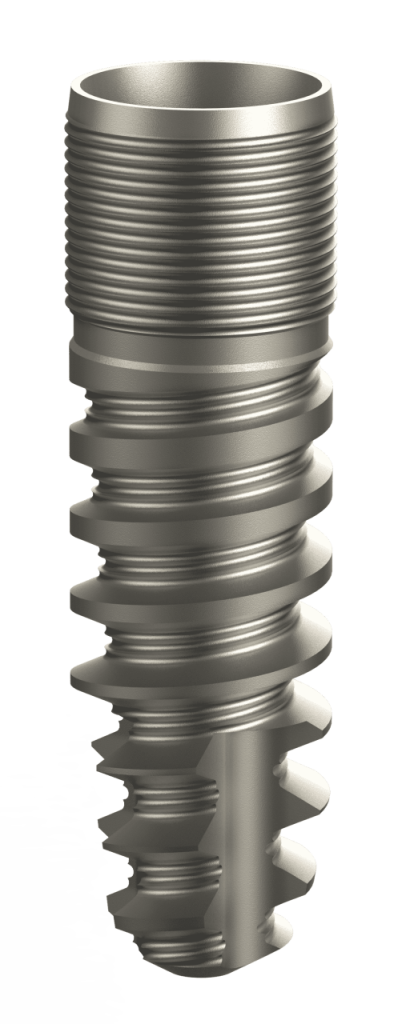
INDICATIONS:
• FOR THE TREATMENT OF UPPER MAXILLARY EDENTULUS
• INDICATED IN BONE CLASSES D3 – D4
• INCREASES PRIMARY STABILITY IN BONE D3 – D4
• EASY TO INSERTION
• THE DOUBLE THREAD WITH PROGRESSIVE TAPER COMPACTS THE BONE DURING INSERTION
AVAILABLE:
Diameter: 3.5 – 4.0 – 4.5 – 5.0 – 5.5
Normal Length: 8 mm – 9 mm – 10 mm – 11 mm – 12 mm
Long Length: 13 mm – 14 mm – 15 mm – 16 mm – 18 mm
Material: Grade 4 Titanium
Soft bone management represents one of the most delicate challenges in implantology. The two-stage implant dedicated to D3–D4 densities was created to offer clinicians a reliable solution,capable of ensuring high primary stability even in the most complex anatomical contexts. Itsaggressive macro-geometry, designed to increase bone condensation during insertion, allows forsecure anchorage in sites with low trabecular density.
The deep, progressive thread, combined with an optimized conical profile, ensures controlledadvancement and uniform distribution of forces, reducing the risk of loss of stability in the first fewdays after surgery. This design makes the implant particularly suitable for thin ridges, post-extractionsites, and posterior areas with low-density bone.
The internal conical connection with hexagonal anti-rotation reduces the microgap and limitsmicromovements between the implant and abutment, contributing to marginal bone preservationand prosthetic longevity.
For the clinician who frequently operates in soft bone conditions, the D3–D4 biphasic implant represents a strategic choice: a device designed to maximize predictability, reduce operating timesand guarantee stable long-term results.
INDICATIONS:
• FOR THE TREATMENT OF UPPER MAXILLARY EDENTULUS
• INDICATED IN BONE CLASSES D3 – D4
• INCREASES PRIMARY STABILITY IN BONE D3 – D4
• EASY TO INSERTION
• THE DOUBLE THREAD WITH PROGRESSIVE TAPER COMPACTS THE BONE DURING INSERTION
AVAILABLE:
Diameter: 3.5 – 4.0 – 4.5 – 5.0 – 5.5
Normal Length: 8 mm – 9 mm – 10 mm – 11 mm – 12 mm
Long Length: 13 mm – 14 mm – 15 mm – 16 mm – 18 mm
Material: Grade 4 Titanium
1. Clinical Context: D3–D4 Bone
Implants intended for D3–D4 bone must guarantee high primary stability in conditions of low bone density.
• D3 → medium density cancellous bone.
• D4 → very soft, highly trabecular bone.
In these situations, implant design is crucial to success.
2. Technical Features of the Biphasic Implant for D3–D4
Conical or Root-Similar Macro-Design
• Promotes lateral compression of the cancellous bone.
• Increases primary stability even in very low densities.
• Ideal for post-extraction sites and regenerated bone.
Triple Thread Thread
• Increases BIC (Bone-to-Implant Contact).
• The threads with progressive height are self-tapping at the apex.
• The surgical site is prepared with step drills with progressive diameters to optimize the drilling diameter.
• Allows for faster and more controlled insertion.
• Reduces surgical trauma in soft bone.
• The additional threads promote bone growth and the particular shape of the thread progressively compacts the bone laterally during implantinsertion.
Crestal Micro-Thread
• Cortical engagement even when the cortex is thin.
• Reduction of crestal bone resorption.
• Better control of the emergence profile.
Stable Internal Connection (Cone + Internal Hexagon)
• Double coupling for maximum mechanical stability.
• Reduction of micro-movements during healing.
• More effective antibacterial seal, thanks to platform switching.
SLA Surface (sandblasting + Double Acidification)
• Controlled roughness for rapid osseointegration.
• Better clot retention in the early stages of healing
• Essential in cases of cancellous or regenerated bone.
Progressive Rotation Apical Outlet
• Allows the outflow of bone chips.
• Reduces apical pressure during insertion.
• Improves stability in D4 bone.
3. Ideal Clinical Uses:
Posterior Maxillary Areas
Where bone density is physiologically lower.
Post-Extraction Sites:
The cylindrical shape and progressive conical thread improve initial grip.
Regenerated or Newly Formed Bone Sites
: Immediate Loading (in selected cases).
Single, Multiple, and Full-Arch Rehabilitations
. Surgical protocols adapted to bone density.
4. Advantages for the Clinician
• High primary stability even in soft bone.
• Absence of micromovements.
• Faster osseointegration thanks to the treated surface.
• Maintenance of crestal bone level with microthread + platform switching.
• Clinical predictability even in complex cases.
• Surgical versatility in all implant procedures.
5. In Summary
A two-stage implant designed for D3–D4 bone must combine:
• a macro-cylindrical design with progressive conical thread,
• an aggressive thread,
• a crestal microthread,
• a stable internal connection,
• an SLA surface.
These features allow for primary stability, rapid osseointegration, and clinical success even in the most unfavorable bone conditions.
Platform Switching
is a dental implant design solution in which the diameter of the prosthetic abutment is intentionally smaller than the implant platform. This retraction of the connection creates a safety space between the crestal bone and the implant-abutment microgap.
Main benefits:
🔹Crestal bone preservation:
The more internal connection distances the microgap from the bone, reducing inflammation and limiting physiological bone loss.
🔹Soft tissue stability
: With more stable bone, the gingiva also maintains a more harmonious and predictable profile, improving the aesthetics of the result.
🔹Better biological seal
: The distance between the bone and the microgap reduces the risk of bacterial infiltration, contributing to the long-term health of the implant.
🔹Prosthetic longevity :
A stronger bone base ensures greater stability of the prosthesis, reducing complications and improving the duration of treatment.
Scrivici!

Questo sito è rivolto esclusivamente a professionisti del settore odontoiatrico.
Le informazioni presenti riguardano dati, prodotti e materiali sensibili, fondamentali per la tutela della salute e della sicurezza del paziente.
Per accedere al sito, dichiaro sotto la mia responsabilità di essere un operatore sanitario.