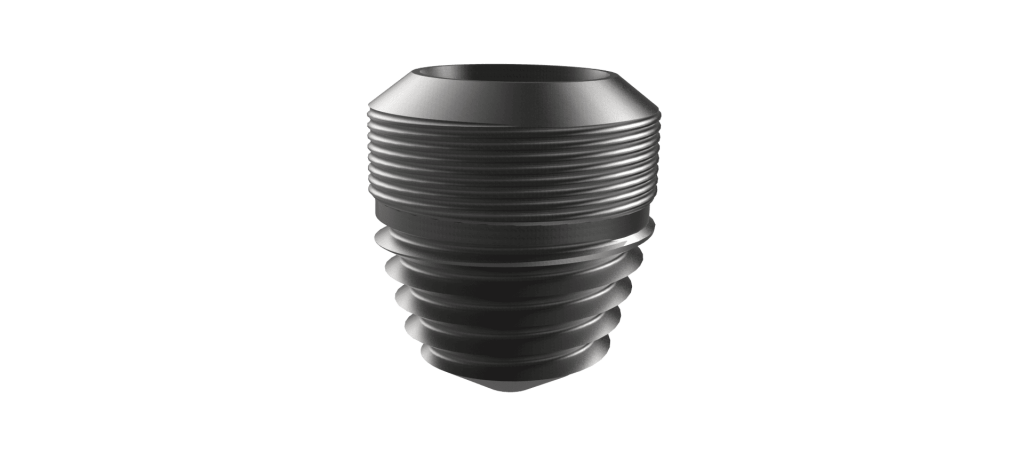
INDICATIONS:
• MANDIBULAR/MAXILLARY IMPLANTO-PROSTHETIC TREATMENTS
• INDICATED IN BONE CLASSES D1 – D2 – D3 – D4
• SUITABLE FOR SEVERE MANDIBULAR AND MAXILLARY VERTICAL ATROPHIES
AVAILABLE:
Diameter: 5.5 – 6.0 – 7.0
Length: 6 mm – 7 mm
Material: Grade 4 Titanium
Short dental implants represent a modern and highly specialized solution forrehabilitation in challenging anatomical conditions, where residual bone height is limitedand regenerative procedures are invasive or contraindicated. Designed to maximizeprimary stability in limited vertical spaces, short implants combine compact geometrieswith advanced macro-designs, ensuring secure anchorage even in atrophic posteriorridges.
The implant’s reduced length is compensated for by an optimized thread profile, SLA-treated surfaces, and a force distribution designed to minimize marginal loads. Thisapproach preserves residual bone stock, reduces the need for regenerative procedures,and simplifies the entire surgical procedure.
Short implants prove particularly effective in the posterior areas of the mandible andmaxilla, where proximity to critical anatomical structures—such as the inferior alveolarnerve or maxillary sinus—limits the use of conventional implants. Their versatility makesthem a reliable choice for single and multiple rehabilitations, and for selected immediateloading protocols.
For clinicians seeking minimally invasive, predictable, and biomechanically sound solutions,the short implant represents a concrete opportunity to achieve stable, long-term resultswhile reducing surgical time, risks, and complexity.
INDICATIONS:
• MANDIBULAR/MAXILLARY IMPLANTO-PROSTHETIC TREATMENTS
• INDICATED IN BONE CLASSES D1 – D2 – D3 – D4
• SUITABLE FOR SEVERE MANDIBULAR AND MAXILLARY VERTICAL ATROPHIES
AVAILABLE:
Diameter: 5.5 – 6.0 – 7.0
Length: 6 mm – 7 mm
Material: Grade 4 Titanium
Short implants are 6mm and 7mm long, designed to rehabilitate bone crests with reduced height, avoiding invasive regenerativeprocedures.
1. Main technical features
2. Short length (6 – 7 mm)
– Short implants are designed to be inserted into crests with limited bone height, avoiding vertical regeneration.
3. Two-stage design
– endosseous screw inserted into the bone, prosthetic abutment screwed in the second surgical phase (except for immediateloading)
4. Optimized thread design
– Differentiated thread pitch: reduced pitch in the coronal portion (microthread) to increase cortical stability; wider pitch in theimplant body to facilitate bone condensation.
– Aggressive macrothreads to increase primary stability
– Progressive thread to better distribute forces
– The cylindrical-conical shape of the implant combined with a highly shearing thread shape ensure excellent primary stability ofthe implant even in cases of soft bone.
2. Surface Treatment
5. SLA surface treatment (sandblasting + double acidification)
– Promotes rapid osseointegration.
– Increases the bone-implant contact surface.
– Improves osseointegration even in short implants.
6. Stable prosthetic connection
– Morse taper connection with anti-rotation internal hexagon
– platform switching
– greater biomechanical control
3. Clinical indications:
Short implants are indicated when bone height is low, but bone quality is sufficient to ensure excellent primary stability.
– Indicated for selective immediate loading in the presence of good primary stability.
– Moderate vertical atrophy
– Posterior maxillary and mandibular areas
– Patients with contraindications to invasive procedures
– Replacement of single teeth or small bridges
4. Clinical advantages
– Less invasive than bone regeneration treatments
– Lower costs than complex regenerative procedures
– High predictability when used correctly
– Reduces/eliminates the number of situations requiring additional regenerative treatments;
– Allows for simpler and more predictable treatments.
Limitations and considerations
– Not indicated in cases of severe bone atrophy (where zygomatic or pterygoid muscles are needed)
– Requires good bone quality for primary stability
– Not ideal for very large bridges
– More delicate biomechanics → need for correct distribution of masticatory forces
It is a dental implant design solution in which the diameter of the prosthetic abutment is intentionally smaller than the implant platform. This retraction of the connection creates a safety space between the crestal bone and the implant-abutment microgap.
Main benefits:
🔹Crestal bone preservation:
The more internal connection distances the microgap from the bone, reducing inflammation and limiting physiological bone loss.
🔹Soft tissue stability
: With more stable bone, the gum also maintains a more harmonious and predictable profile, improving the aesthetics of the result.
🔹Better biological seal:
The distance between the bone and the microgap reduces the risk of bacterial infiltration, contributing to the long-term health of the implant.
🔹Prosthetic longevity:
A more solid bone base ensures greater stability of the prosthesis, reducing complications and improving the duration of treatment.
Scrivici!

Questo sito è rivolto esclusivamente a professionisti del settore odontoiatrico.
Le informazioni presenti riguardano dati, prodotti e materiali sensibili, fondamentali per la tutela della salute e della sicurezza del paziente.
Per accedere al sito, dichiaro sotto la mia responsabilità di essere un operatore sanitario.